

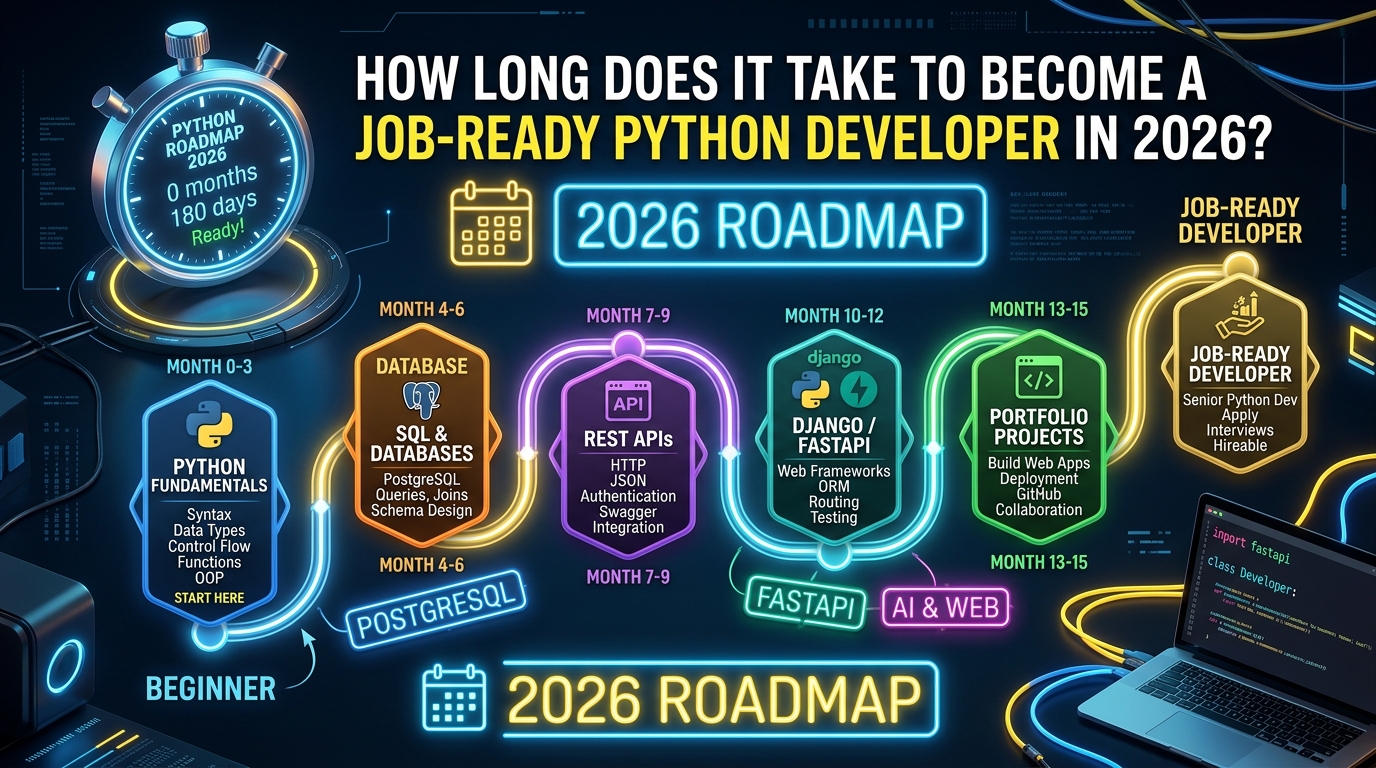
One of the most frequent and pressing questions aspiring software engineers, students, and career switchers ask when beginning their coding journey is: "How long will it actually take me to become a job-ready Python developer in 2026?"
The honest answer is that there is no magical one-size-fits-all formula. Memorizing basic Python syntax (variables, loops, conditionals) can be accomplished in 2 to 4 weeks. However, writing basic syntax is vastly different from becoming job-ready. Being hireable requires understanding how to design database schemas, architect RESTful APIs, manage version control with Git, write automated tests, deploy live cloud applications, and solve real business problems independently.
For a focused learner studying consistently for 15 to 20 hours per week, a 3 to 6-month structured learning roadmap provides an exceptionally strong foundation for securing entry-level developer roles. In this definitive guide, we break down the realistic timelines, explain what "job-ready" actually means, provide 3-month and 6-month roadmaps, analyze the Django vs FastAPI debate, outline essential portfolio projects, and guide you on interview preparation.
🎁 Download Free: Python Developer Roadmap 2026 — 6-Month Job-Ready Checklist
Want to become a job-ready Python developer? Download our free 6-month Python Developer Roadmap PDF and track your progress from beginner fundamentals to real-world production projects. Features 11 pages of checklists, SQL/API cheat sheets, 10 project ideas, and interview preparation guides.
How Long Does It Take to Learn Python?
The time required to learn Python depends directly on your learning objective. Learning syntax is quick; learning software engineering takes deliberate effort:
| Learning Milestone | Approximate Timeline* | What You Can Actually Build |
|---|---|---|
| Basic Syntax | 2–4 Weeks | Simple calculators, text-based games, basic math scripts |
| Programming Fundamentals | 1–2 Months | Data manipulation, file processing, basic CLI automation tools |
| Intermediate Python & OOP | 2–3 Months | Modular object-oriented programs, web scrapers, data structures |
| Backend Web Applications | 3–5 Months | REST APIs with FastAPI/Django, database integration with PostgreSQL |
| Job-Ready Foundation | 3–6+ Months | Full-stack portfolio projects, deployed cloud backends, Git workflows |
| Professional Production Mastery | 1+ Years | High-scale distributed systems, system design, performance optimization |
*Note: Estimates assume 15–20 hours of focused weekly study. Daily active coding produces faster progress than weekend-only cramming.
How Long Does It Take to Become Job-Ready?
Depending on your starting point and weekly time investment, your journey typically falls into one of three realistic brackets:
⚡ 3-Month Fast Track
Achievable for students with prior programming exposure (C/C++ or Java from college) dedicating 25–30 hours weekly to intensely build 2–3 deployed API projects.
🎯 6-Month Standard Track (Recommended)
The ideal path for complete beginners and non-tech graduates. Provides sufficient time to absorb Python, master SQL, build 4 portfolio projects, and prepare for interviews.
🚀 9–12 Month Comprehensive Track
Suited for working professionals studying 7–10 hours weekly, or those aiming to specialize deeply in Machine Learning, AI Engineering, or Data Science alongside backend web dev.
What Does "Job-Ready Python Developer" Actually Mean?
Being "job-ready" does not mean memorizing every Python library. It means an employer can assign you a user story, and you can build, test, and deploy the solution without needing hand-holding for every line of code.
✅ The Minimum Job-Ready Technical Standard
- Write clean, PEP 8 compliant, modular Python code with functions and classes
- Interact with relational databases using SQL (joins, aggregations, filtering) and ORMs (SQLAlchemy / Django ORM)
- Build RESTful APIs with clean HTTP request/response payloads, authentication, and error validation
- Use Git and GitHub collaboratively (branches, commits, pull requests, merge conflict resolution)
- Systematically debug errors by reading stack traces rather than randomly changing code
- Deploy at least one live, production web service with database persistence on cloud platforms
Python Developer Roadmap for Beginners (10 Practical Steps)
Step 1 — Learn Python Fundamentals
Variables, data types (int, float, string, bool), conditionals (if/elif/else), loops (for, while), functions with arguments and return values, modules, exception handling (try/except), and basic file I/O operations.
Step 2 — Learn Data Structures & Problem Solving
Master Python's built-in collections: Lists, Tuples, Dictionaries, and Sets. Understand when to choose a dictionary over a list for O(1) lookup speed. Practice algorithmic problem solving on string parsing and array manipulation.
Step 3 — Learn Object-Oriented Programming (OOP)
Understand classes, objects, constructors (__init__), instance methods, inheritance, encapsulation, polymorphism, and composition. OOP is the architectural language of enterprise backend codebases.
Step 4 — Learn Git and GitHub
Master version control early: git init, git add, git commit, git branch, git merge, and git push. Maintain an active GitHub profile with well-documented README files.
Step 5 — Learn SQL and Relational Databases
A backend developer who cannot write SQL is incomplete. Master PostgreSQL: creating tables, primary/foreign keys, writing joins (INNER, LEFT), grouping, indexing, and transactions.
Step 6 — Learn REST APIs
Understand how frontends communicate with backends over HTTP: GET, POST, PUT, PATCH, DELETE, status codes (200, 201, 400, 401, 404, 500), headers, JSON parsing, and CORS policies.
Step 7 — Choose a Python Framework (FastAPI vs Django)
Pick one framework to master first. Choose FastAPI if you want modern, high-speed, asynchronous REST APIs with automatic OpenAPI docs. Choose Django if you want full-featured web development with built-in admin panels and ORM.
Step 8 — Learn Testing and Debugging
Write unit tests using pytest. Practice debugging with breakpoints in VS Code and reading Python tracebacks calmly.
Step 9 — Build Real-World Projects
Build 3 to 4 portfolio projects that solve realistic user problems (see project section below).
Step 10 — Deploy Your Applications to the Cloud
Deploy your APIs and databases to production on cloud hosting platforms like Render, Railway, or AWS EC2. Configure environment variables securely in .env files.
Django vs FastAPI: Which Should You Learn in 2026?
| Feature | Django | FastAPI |
|---|---|---|
| Primary Architecture | Full-Stack "Batteries-Included" Monolith | Modern, Asynchronous Microservices & APIs |
| Built-in Admin Panel | ⭐⭐⭐⭐⭐ Automatic & Incredible | None (API-first design) |
| Execution Speed | Good (WSGI standard) | ⭐⭐⭐⭐⭐ Blazing Fast (ASGI / Uvicorn) |
| Type Hints & Validation | Django Forms / Serializers | ⭐⭐⭐⭐⭐ Native Pydantic Validation |
| Interactive API Docs | Requires third-party packages | ⭐⭐⭐⭐⭐ Built-in Swagger UI & ReDoc |
| Best Suited For | Full web apps, content portals, SaaS | REST APIs, microservices, AI/ML endpoints |
Recommendation: If your target is building APIs to power React frontends or serve AI models, choose FastAPI. If you want an all-in-one framework with authentication and admin tooling ready out of the box, choose Django.
Realistic 6-Month Python Developer Roadmap
| Month | Core Learning Focus | Monthly Project Milestone |
|---|---|---|
| Month 1 | Python Syntax, Control Flow, Functions, Data Structures | Interactive Expense Tracker CLI with JSON persistence |
| Month 2 | OOP, Modules, File Handling, Git & GitHub | Student Course Enrollment System using OOP classes |
| Month 3 | Relational Databases, PostgreSQL, Advanced SQL Queries | E-Commerce Relational Database Schema & complex SQL joins |
| Month 4 | FastAPI or Django, REST API Architecture, Routing | Task Management & Note-Taking REST API with Swagger Docs |
| Month 5 | JWT Authentication, SQLAlchemy/ORM, Role-Based Access | Full Production Backend API with user auth & protected routes |
| Month 6 | Testing (pytest), Docker, Cloud Deployment & Mock Interviews | Live Deployed Multi-Service Portfolio on GitHub with live URL |
High-Impact Python Portfolio Projects for Beginners
1. Task Management & Collaboration API
User registration, JWT authentication, task creation with categories, due dates, priority tags, and automated email reminders.
Stack: FastAPI, PostgreSQL, SQLAlchemy, Pydantic, pytest.2. E-Commerce Backend with Payment Gateway
Product catalog with search, cart management, order checkout, Stripe/Razorpay sandbox integration, and role-based admin dashboard.
Stack: Django, Django REST Framework, PostgreSQL, Docker.3. AI-Powered Document Analyzer & Q&A Service
Uploads PDF documents, generates semantic embeddings, performs retrieval-augmented generation (RAG) using LangChain and OpenAI APIs, and streams answers.
Stack: Python, FastAPI, LangChain, ChromaDB / pgvector, Render.Is Python Development a Good Career in 2026?
Yes. According to Stack Overflow's 2025 Developer Survey (49,019 respondents across 177 countries), Python's adoption surged by 7 full percentage points year-over-year, driven by the global expansion of AI, data engineering, and rapid backend microservices. Furthermore, GitHub's 2025 Octoverse Report confirmed Python as the #2 most widely used programming language in the world, with immense community activity and open-source momentum.
Final Verdict
Becoming a job-ready Python developer typically takes 3 to 6 months of disciplined, structured effort. The key is to avoid getting stuck in "tutorial hell." Measure your progress not by the number of hours you watch videos, but by the tangible projects you build, debug, and deploy independently.
Download Free Python Developer Roadmap 2026 — PDF Checklist
Keep this printable 11-page study planner, skill checklist, SQL reference, and interview question guide with you as you code your way to job readiness.
Recommended Industry-Aligned Training Tracks
Aptech Learning Gurugram provides hands-on Python programs with live project coaching, resume critiques, and placement assistance:
Smart Pro Python Web Development Track →
Comprehensive 7-month track covering Core Python, Django, REST APIs, SQL, and cloud deployment.
Smart Pro Data Science & AI Track →
Master Python for data analytics, machine learning algorithms, deep learning neural nets, and AI applications.
Java vs Python: Which to Learn First? →
Compare learning difficulty, AI vs enterprise backend career paths, and salaries.
Full Stack Developer Roadmap 2026 →
Step-by-step roadmap covering HTML, CSS, JavaScript, React, Node.js, and SQL.
Frequently Asked Questions (FAQs)
Q1. How long does it take to learn Python?
Basic syntax can be learned in 2 to 4 weeks. However, developing the ability to build backend web applications, query databases, and write production APIs typically takes 3 to 6 months of consistent practice.
Q2. Can I become a Python developer in 3 months?
Yes, if you already have some prior coding exposure and can dedicate 25 to 30 hours weekly to building and deploying real-world API projects. For complete beginners, 4 to 6 months is a more realistic timeframe.
Q3. Can I learn Python in 6 months?
Yes. Six months provides sufficient runway to master Python fundamentals, OOP, SQL databases (PostgreSQL), web frameworks (FastAPI or Django), testing, and deployment of 3 to 4 portfolio projects.
Q4. Is Python easy for beginners?
Yes. Python is globally recognized as one of the most beginner-friendly languages because its syntax closely mirrors natural English, avoiding the strict boilerplate of languages like Java or C++.
Q5. Do I need Django to become a Python developer?
Not necessarily. Django is fantastic for full-stack web applications, but FastAPI has become equally popular for building high-performance REST APIs and microservices. You only need to master one first.
Q6. Is SQL necessary for Python developers?
Yes. Every commercial Python application interacts with databases. Understanding SQL queries, joins, indexes, and transactions is essential for passing technical interviews.
Q7. Can I get a Python developer job without a CS degree?
Yes. Tech recruiters evaluate your GitHub portfolio, deployed applications, problem-solving skills, and interview performance far more than your college degree.
Q8. What should I learn after Python fundamentals?
The proven sequence is: OOP & Data Structures → Git & GitHub → SQL (PostgreSQL) → Web Framework (FastAPI or Django) → REST APIs & Auth → Testing → Cloud Deployment.
📞 Ready to Accelerate Your Python Career Timeline?
Talk to EduQuest's senior academic mentors at +91 99580 41888 or visit our classroom training center at Galleria Market, DLF Phase-IV, Gurugram. We provide hands-on project coaching, resume reviews, and placement assistance to help you get hired faster.