

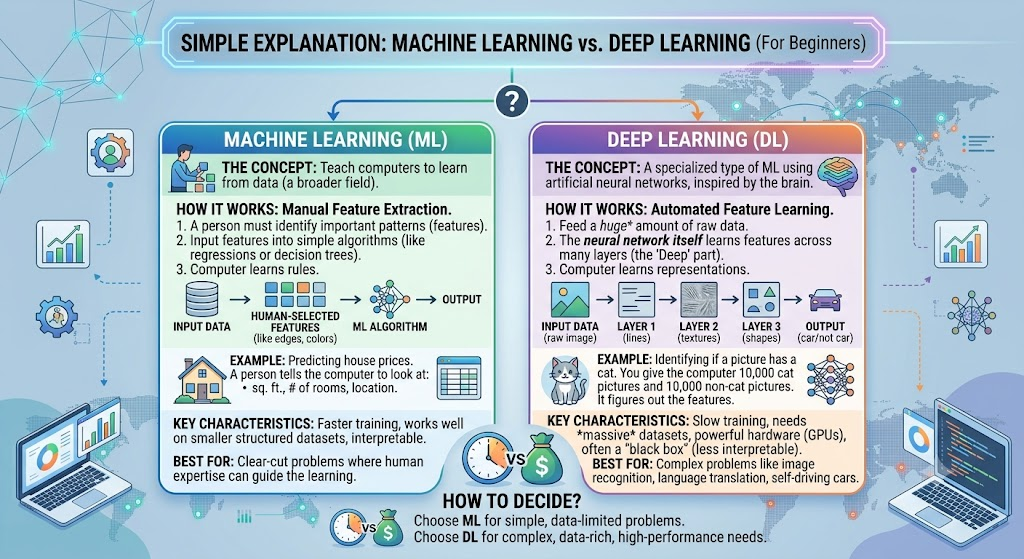
If you're new to the world of artificial intelligence, "machine learning" and "deep learning" probably sound like two fancy buzzwords for the exact same thing. They're not — but they are closely related, and understanding the clear line between them is one of the most practical and essential first steps in any AI or data science learning journey.
This guide breaks down the fundamental differences in plain English, with concrete everyday examples, visual analogies, and a side-by-side comparison table — so you truly grasp the concepts rather than simply memorizing definitions for an interview.
Download Free ML vs DL Quick Reference Cheat Sheet (PDF)
Get instant access to side-by-side comparison matrices, feature engineering cheat sheets, hardware requirements, and beginner learning roadmaps.
The One-Line Answer
Deep learning is a specialized subset of machine learning. Every deep learning model is a machine learning model, but not every machine learning model is deep learning.
Think of it as nested circles:
- Artificial Intelligence (AI): The broadest umbrella — any computer system designed to perform tasks that typically require human intelligence.
- Machine Learning (ML): The approach within AI where systems learn patterns automatically from data, instead of following hardcoded rules.
- Deep Learning (DL): A specific, high-powered technique inside ML that uses multi-layered artificial neural networks inspired by the human brain.
What Is Machine Learning? (Simple Explanation)
Machine Learning (ML) is a method of programming computers to learn from historical examples instead of writing rigid "if-then" rules by hand.
❌ Traditional Rule-Based Code
You manually write exact logic: "If email contains 'lottery' and 'urgent wire transfer', send to spam folder." As spammers change words, you have to keep writing new rules.
✅ Machine Learning Approach
You feed the computer 50,000 emails labeled "spam" and "not spam". The ML algorithm mathematically discovers which words, sender domains, and structures indicate spam on its own.
Everyday Examples of Machine Learning
- Netflix & Spotify Recommendations: Analyzing your watch and listening history against millions of other users to suggest what you'll enjoy next.
- Banking Fraud Detection: Flagging unusual transactions (e.g. sudden overseas swipe at 3 AM) based on past spending anomalies.
- Real Estate Price Forecasting: Predicting property values based on square footage, location coordinates, age, and bedroom counts.
- Email Spam Filters: Gmail filtering promotional newsletters and junk mail into categorized tabs.
Classic ML algorithms (like Linear Regression, Random Forests, Logistic Regression, and XGBoost) excel with structured, tabular data (spreadsheets and SQL tables) and typically require a human engineer to choose the relevant features (columns).
What Is Deep Learning? (Simple Explanation)
Deep Learning (DL) is a branch of machine learning powered by Artificial Neural Networks — layered computational structures loosely inspired by biological neurons in the human brain. Unlike classic ML, deep learning discovers and engineers its own features directly from raw data, without human guidance.
The word "Deep" refers to having many hidden layers (often dozens or hundreds) stacked on top of each other. Each consecutive layer detects progressively higher-level patterns.
💡 The Cat Recognition Analogy
In Classic ML, an engineer must manually specify attributes: "look for triangular ears, whisker pixels, fur textures."
In Deep Learning, you simply feed the neural network 20,000 cat images. Layer 1 identifies basic pixel edges; Layer 2 combines edges into curves and textures; Layer 3 recognizes ears and noses; and the final layer determines whether the image is a cat. The network figures out what makes a cat on its own.
Everyday Examples of Deep Learning
- Face Unlock & Computer Vision: Instant facial recognition on your iPhone or security systems.
- Voice Assistants: Apple Siri, Google Assistant, and Amazon Alexa interpreting conversational speech audio.
- Autonomous Driving: Tesla and Waymo self-driving systems detecting pedestrians, lane markers, and traffic signs in real-time video feeds.
- Generative AI & LLMs: OpenAI ChatGPT, Claude, and Midjourney generating fluent prose and photorealistic images from textual descriptions.
Side-by-Side Comparison: Machine Learning vs. Deep Learning
| Factor | Machine Learning (ML) | Deep Learning (DL) |
|---|---|---|
| Core Concept | Broad category of data-driven learning | Specialized subset using multi-layer neural nets |
| Data Needed | Works well with small to medium datasets (thousands of rows) | Requires massive datasets (millions of data points / images) |
| Feature Selection | Manual feature engineering by humans | Learned automatically across hidden network layers |
| Hardware Requirements | Runs comfortably on standard laptop CPUs | Requires dedicated high-performance GPUs / TPUs |
| Ideal Data Type | Structured / Tabular data (Excel, SQL, CSVs) | Unstructured data (Images, Audio, Video, Text) |
| Training Time | Fast (seconds to a few hours) | Slow (hours, days, or weeks of cluster computing) |
| Interpretability | High (clear decision trees, coefficients) | Low ("Black Box" — billions of weight parameters) |
| Key Examples | Spam filters, credit risk scoring, churn prediction | ChatGPT, Tesla Autopilot, Midjourney, FaceID |
Why Does Deep Learning Need So Much Data?
Beginners often ask why deep learning fails when tested on smaller datasets. The reason comes down to parameter scale:
- A classical machine learning model (like Linear Regression or a Decision Tree) might adjust 10 to 1,000 parameters. It can easily discover reliable statistical boundaries with just a few thousand rows.
- A deep neural network (like a ResNet or GPT architecture) has millions or billions of interconnected weight parameters. Without massive data to tune those weights, the network simply memorizes the training data without understanding real general patterns — an issue known as overfitting.
For standard corporate business problems involving structured customer tables, sales data, or spreadsheets, classic machine learning is frequently the superior, cheaper, and faster choice.
Which One Should You Learn First?
Always learn classical Machine Learning fundamentals first. Deep learning builds directly on the foundational concepts of ML — you cannot truly grasp why neural networks optimize without understanding cost functions, gradient descent, train/test validation splits, bias-variance tradeoffs, and evaluation metrics (Precision, Recall, ROC-AUC).
Python & Statistics Fundamentals
Learn Python, NumPy, pandas, exploratory data analysis, and core probability/statistics.
Core Classical Machine Learning
Master regression, classification, decision trees, random forests, and model evaluation using scikit-learn.
Neural Network Foundations
Understand perceptrons, activation functions (ReLU, Sigmoid), backpropagation, and loss optimizers using PyTorch or TensorFlow.
Deep Learning Specialization (CNNs & Transformers)
Deepen skills in Convolutional Neural Networks (CNNs) for Computer Vision, and Transformer architectures for Natural Language Processing and Generative AI.
Common Myths, Busted
- "Deep learning is always better than machine learning." False. For structured tabular datasets with fewer than 100,000 rows, classic algorithms (like XGBoost or LightGBM) regularly outperform deep neural networks while running 100x faster.
- "You need deep learning to get any job in AI." False. The vast majority of data analyst, business intelligence, and junior data science roles in India rely heavily on SQL and classic machine learning.
- "Machine learning and AI are synonyms." False. AI is the broad goal of simulating human intelligence. Machine learning is the method to achieve it via data, and deep learning is one specialized tool within that method.
Recommended Industry-Aligned Training Tracks
Aptech Learning Gurugram provides structured classroom and hybrid programs with live project coaching and placement drives:
Smart Pro Data Science & AI Track →
Comprehensive 9-month professional track covering Python, ML, Deep Learning & AI.
Generative AI Careers 2026 Guide →
Explore high-paying GenAI roles, 4 skill pillars, and required RAG/LLM tool stacks.
SQL vs Python vs R Decision Guide →
Determine which programming language to learn first based on your target role and timeline.
Frequently Asked Questions (FAQs)
Q1. Is deep learning a part of machine learning?
Yes. Deep learning is a specialized subset of machine learning that uses multi-layered neural networks, and every deep learning model is technically a machine learning model.
Q2. Do I need to learn advanced math for machine learning and deep learning?
Basic statistics, linear algebra, and calculus help you understand what's happening under the hood, but many beginners start building working models using libraries like scikit-learn (ML) and PyTorch (DL) before diving deep into the underlying math.
Q3. Which is easier to learn first, ML or DL?
Machine learning is generally easier to start with — the concepts are more intuitive, datasets are smaller, and results are easier to interpret, making it the natural first step before tackling deep learning.
Q4. Can I skip machine learning and go straight to deep learning?
You can, but it is not recommended. Core ML concepts like overfitting, train/test splits, and model evaluation apply directly to deep learning too, so skipping them makes deep learning much harder to truly master.
Download Free ML vs DL Quick Reference Cheat Sheet (PDF)
Keep this handy printable comparison matrix, workflow summary, and career roadmap with you as you plan your AI learning journey.
Final Word
Machine learning and deep learning are not competing technologies — deep learning is simply a more powerful, compute-heavy technique that lives inside the broader discipline of machine learning. Grasping this structural difference is one of the clearest signs of real AI literacy — and it sets you on the right path toward mastering modern AI.
📞 Need Help Planning Your AI/ML Learning Path?
Talk to EduQuest's academic counselors at +91 99580 41888 or visit our center at Galleria, DLF Phase-IV, Gurugram. We will help you chart out a step-by-step AI curriculum based on your career goals.