

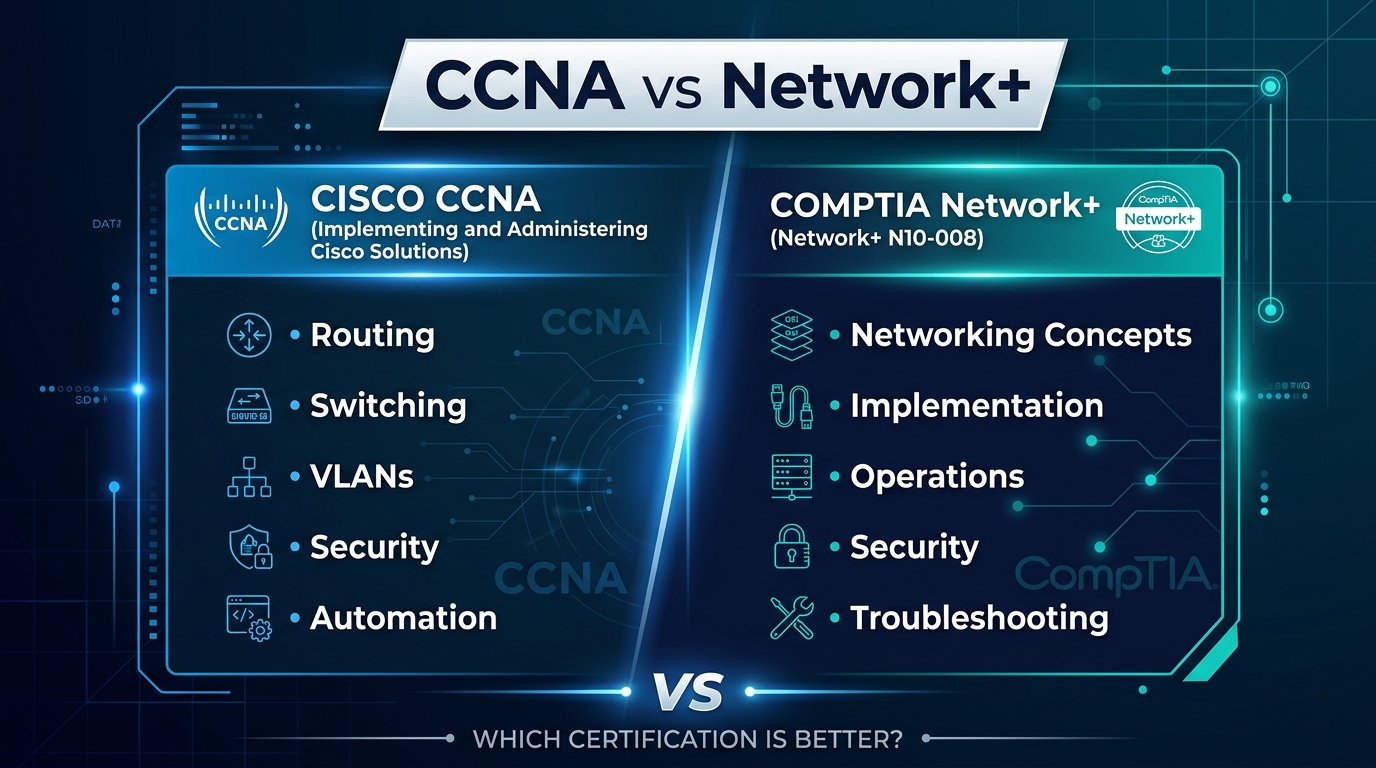
If you want to start a high-growth career in computer networking, systems administration, or cybersecurity, two credentials will inevitably dominate your research: Cisco CCNA (200-301) and CompTIA Network+ (N10-009).
Both credentials can help you cultivate robust networking literacy, but they are architected with fundamentally different philosophies, learning curves, and industry destinations.
CompTIA Network+ is completely vendor-neutral. It concentrates on broad networking fundamentals, multi-vendor hardware implementations, operational hygiene, foundational security controls, and vendor-agnostic troubleshooting across diverse environments.
Cisco CCNA, on the other hand, is Cisco's premier associate-level networking credential. While it teaches global networking concepts, it dives significantly deeper into hands-on configuration, routing and switching mechanics, command-line interface (CLI) execution on Cisco IOS, network security access control lists (ACLs), and contemporary network automation and programmability.
So which certification should a beginner, fresher, or career switcher choose in 2026? The answer depends entirely on your specific career trajectory, technical background, and target job roles.
If you want a broad, vendor-agnostic networking baseline to support general IT support, systems administration, or cloud helpdesk roles, Network+ is a solid option. However, if your ambition is to become a dedicated network engineer, NOC analyst, infrastructure specialist, or work with enterprise routers, switches, and firewalls, CCNA delivers the technical depth and market recognition that enterprise employers demand.
🎁 Download Free: CCNA vs Network+ Career Decision Guide 2026 (PDF)
Not sure whether CCNA or Network+ is right for you? Download our free 8-page 2026 Career Decision Guide featuring a side-by-side comparison matrix, complete syllabus & exam comparison, career pathways, an interactive beginner decision tree, CCNA & Network+ study checklists, and a structured 30-day networking fundamentals plan.
CCNA vs Network+: Quick Comparison
Before diving into individual topic syllabi and exam mechanics, examine this high-level side-by-side comparison of Cisco CCNA and CompTIA Network+:
Cisco currently outlines CCNA competency across six critical domains: network fundamentals, network access, IP connectivity, IP services, security fundamentals, and automation/programmability.
CompTIA's current Network+ N10-009 exam objectives organize networking knowledge into five major domains: networking concepts, network implementation, network operations, network security, and network troubleshooting.
What Is Cisco CCNA?
CCNA stands for Cisco Certified Network Associate. Administered by Cisco Systems, the worldwide leader in enterprise networking equipment and software, it is arguably the most recognizable and respected associate-level networking certification in the global IT sector.
The current single-exam version is 200-301 CCNA (Implementing and Administering Cisco Solutions). Cisco structured this modern version by consolidating previously fragmented tracks (such as CCNA Routing & Switching, CCNA Security, and CCNA Wireless) into a single, cohesive, forward-looking credential.
According to Cisco's official exam blueprint, the CCNA test assesses candidates across six domains:
- Network Fundamentals (20%): OSI and TCP/IP models, IPv4 subnetting, IPv6 addressing, network topologies, physical cabling, and virtualization concepts.
- Network Access (20%): VLANs, 802.1Q trunks, Spanning Tree Protocol (STP), EtherChannel (LACP), Cisco Discovery Protocol, and Enterprise Wi-Fi architecture.
- IP Connectivity (25%): Routing tables, static routing, default routes, single-area OSPFv2 routing mechanics, and first-hop redundancy protocols (HSRP).
- IP Services (10%): Network Address Translation (NAT/PAT), NTP, DHCP snooping, DNS, SNMP, Syslog, and SSH configuration.
- Security Fundamentals (15%): Standard and extended IPv4 Access Control Lists (ACLs), Layer 2 port security, dynamic ARP inspection, VPN fundamentals, and AAA concepts.
- Automation and Programmability (10%): Controller-based networking, Software-Defined Networking (SDN), REST APIs, JSON data structures, configuration management tools (Ansible, Puppet, Chef), and AI-assisted network operations.
The CCNA examination does not enforce any mandatory academic prerequisites. The exam duration is 120 minutes, and passing the exam earns a credential valid for three years.
What Is CompTIA Network+?
CompTIA Network+ is an internationally recognized, vendor-neutral networking certification administered by the Computing Technology Industry Association (CompTIA).
Unlike vendor-specific programs that teach you how to configure a particular vendor's proprietary command-line interface, CompTIA Network+ trains you on universal networking concepts and operational standards that remain true whether you are inspecting equipment manufactured by Cisco, Juniper, Aruba, Fortinet, Dell, or MikroTik.
The current exam version is N10-009. The official CompTIA objectives divide the testing blueprint into five specific operational domains:
The current N10-009 exam has a maximum of 90 questions, features a blend of multiple-choice and Performance-Based Questions (PBQs), and enforces a strict 90-minute time limit with a required passing score of 720 on a scale of 100–900.
CCNA vs Network+: Key Differences
The defining contrast between these two certifications lies in their pedagogical methodology and architectural approach:
Cisco CCNA Approach
Core Foundations + Deep Cisco CLI Configuration
↓
Routing & Switching (OSPF, VLANs)
↓
Cisco IOS CLI & Hardware Labs
↓
Infrastructure Security (ACLs, PortSec)
↓
Network Automation, APIs & SDN
CompTIA Network+ Approach
Broad Operational & Multi-Vendor Literacy
↓
Multi-Vendor Implementation & Cabling
↓
Network Operations & Documentation
↓
Network Security Controls & Hardening
↓
7-Step Troubleshooting & Diagnostics
Network+ is architected to give you an expansive, vendor-agnostic foundation. You learn what routers, firewalls, and access points do, how Ethernet cables are crimped (T568A vs T568B), which ports protocols live on, and how to methodically troubleshoot connection outages.
CCNA takes that foundational baseline and immediately pushes into technical implementation. Instead of merely knowing what an 802.1Q trunk is, you must enter Cisco configuration mode, assign interfaces to VLANs, set up native VLAN tags, configure dynamic routing protocols like OSPF, write extended access control lists to filter specific TCP/UDP port packets, and parse JSON payloads returned by network controllers.
CCNA vs Network+: Syllabus Comparison
To truly understand which certification matches your learning ambitions, examine how each syllabus approaches core networking disciplines.
Networking Fundamentals
Both certifications deliver comprehensive coverage of foundational computer networking principles. In both syllabi, you will study:
- OSI 7-Layer Model: Physical, Data Link, Network, Transport, Session, Presentation, and Application layers.
- TCP/IP Protocol Suite: Network Access, Internet, Transport, and Application layers.
- IP Addressing & Subnetting: IPv4 classes, CIDR notation, subnet masks, default gateways, and IPv6 address formats (Global Unicast, Link-Local, SLAAC).
- Network Infrastructure Hardware: Routers, switches, access points, next-generation firewalls, wireless LAN controllers (WLC), and endpoints.
- Standard Network Protocols: DNS (Port 53), DHCP (Ports 67/68), HTTP (80), HTTPS (443), SSH (22), Telnet (23), SNMP (161), and NTP (123).
Thus, at the fundamental conceptual layer, there is roughly 70% direct topical overlap.
Routing Technologies
The gap widens drastically when examining routing:
- CCNA Depth: Cisco places substantial emphasis on routing architecture. You are expected to configure, verify, and troubleshoot static routes, default floating static routes, and dynamic routing with single-area OSPFv2. You must understand administrative distance, metric calculation, router IDs, OSPF neighbor adjacency states, and routing table lookup algorithms. Cisco training demands real hands-on lab work configuring these on virtual or physical routers.
- Network+ Depth: Network+ teaches routing from a high-level, vendor-neutral perspective. You learn the conceptual distinction between interior gateway protocols (IGP like OSPF) and exterior gateway protocols (EGP like BGP), distance-vector vs link-state algorithms, and static routing concepts, but you are not expected to configure proprietary router operating system syntax.
Switching
Switching is another domain where CCNA establishes clear technical dominance:
- CCNA Switching Coverage: Cisco CCNA requires comprehensive command-line mastery of Layer 2 technologies. Candidates must configure and troubleshoot VLANs (Virtual Local Area Networks), 802.1Q inter-switch trunks, Native VLAN security, Inter-VLAN routing (Router-on-a-Stick and Layer 3 Multi-Layer Switch SVIs), Spanning Tree Protocol (STP / Rapid PVST+), and EtherChannel (Link Aggregation using LACP).
- Network+ Switching Coverage: CompTIA covers switching concepts thoroughly — explaining broadcast domains, collision domains, MAC address tables, VLAN isolation, and STP loops — but does not tie your learning path to Cisco IOS CLI commands.
Network Security
Both certifications introduce essential cybersecurity principles, representing high value if you are aiming for a cybersecurity career path or an ethical hacking career:
- CCNA Security Focus: Device hardening, enabling password encryption, configuring SSH v2, setting up AAA (Authentication, Authorization, Accounting) concepts, configuring Layer 2 switchport security (MAC address limiting, sticky MACs, errdisable recovery), DHCP snooping, Dynamic ARP Inspection (DAI), and writing standard and extended IPv4 Access Control Lists (ACLs) to filter packet traffic by IP, port, and protocol.
- Network+ Security Focus: The Network+ exam dedicates 14% of its blueprint to Network Security. It emphasizes defensive architecture: firewall types (stateful, proxy, next-gen), intrusion detection and prevention systems (IDS/IPS), physical security (biometrics, badge readers, mantrap doors), common attack types (DDoS, man-in-the-middle, ARP poisoning, spoofing), and network authentication standards (802.1X, RADIUS, TACACS+).
Automation and Modern Networking
One of the most consequential modern distinctions between the two certifications is how they address network programmability:
Modern networking in enterprise environments is no longer restricted to manually logging into individual command-line terminals to configure devices one by one. Cisco CCNA has modernized by dedicating 10% of its curriculum to Automation & Programmability:
- Software-Defined Networking (SDN): Understanding control plane vs data plane separation and centralized network controllers like Cisco Catalyst Center (formerly DNA Center).
- REST APIs: Interacting with networking hardware via HTTP verbs (GET, POST, PUT, DELETE), authentication headers, and status codes.
- Data Encoding: Interpreting structured configuration payloads formatted in JSON, XML, and YAML.
- Configuration Management: Understanding DevOps and Infrastructure-as-Code automation tools like Ansible, Puppet, and Chef.
- AI & Machine Learning: Cisco's current curriculum introduces AI/ML integration into predictive network monitoring and telemetry.
CompTIA Network+ N10-009 touches on modern network management concepts, but CCNA offers a much direct bridge into Python network automation and modern NetDevOps engineering.
CCNA vs Network+: Exam Comparison
Exam day realities differ significantly between Cisco and CompTIA testing environments:
⚠️ Crucial Exam-Taking Difference: Navigation Restrictions
On the Cisco CCNA exam, you cannot go backwards. Once you submit an answer to a question, it is locked permanently. If you encounter a complex IP subnetting question or a multi-router simulation lab, you must balance your time carefully. On CompTIA Network+, you can flag challenging PBQs, answer all standard multiple-choice questions first, and return to the PBQs with whatever time remains.
Which Certification Is Easier?
There is no universal, one-size-fits-all answer. Difficulty is directly tied to your existing technical background, hands-on lab access, and learning style.
CompTIA Network+ May Feel Easier If:
- You are completely new to networking and computer hardware.
- You prefer mastering conceptual models and protocols rather than memorizing syntax.
- You have never worked with network equipment operating systems.
- You want broad IT literacy applicable across multiple operating systems.
- You appreciate the ability to flag questions and review your answers at the end of the test.
Cisco CCNA May Feel Easier If:
- You already understand basic computer science or IT concepts.
- You learn best through active, hands-on labs (Packet Tracer, GNS3, physical gear).
- You enjoy logical problem-solving, subnetting calculations, and routing mechanics.
- You are targeting a specialized network engineering career.
- You find concrete CLI configurations more memorable than abstract definitions.
Instead of asking "Which exam is easier?", smart students ask: "Which certification's learning style and depth aligns with my 3-year career destination?"
Which Certification Gives More Hands-On Networking Skills?
While both certifications test practical knowledge, Cisco CCNA provides substantially more hands-on, production-grade networking skills.
To pass CCNA, passive memorization is guaranteed to fail. You must spend dozens of hours in software simulators like Cisco Packet Tracer, GNS3, or EVE-NG, or configuring physical switches and routers. You must be able to configure and verify:
↓
Switch Initialization & Port Security
↓
VLAN Creation (VLAN 10, 20, 30) & 802.1Q Trunk Negotiation
↓
Inter-VLAN Routing (Subinterfaces / Router-on-a-Stick)
↓
Dynamic OSPFv2 Routing Mesh with Wildcard Masks
↓
Standard & Extended IPv4 Access Control Lists (ACLs)
↓
Network Address Translation (NAT/PAT Overload)
↓
Packet Trace Debugging via Ping, Traceroute & Show Commands
For someone specifically targeting Network Engineer, NOC Specialist, or Telecom Infrastructure roles, this rigorous CLI fluency is what hiring managers test during technical interviews.
CCNA vs Network+ for Freshers
For college students (B.Tech, BCA, MCA, BSc IT) or recent graduates entering the job market, either certification provides a structured path, but their value proposition diverges:
If you want broad IT knowledge: Network+ gives you a foundational vocabulary. It will help you land entry-level IT Support, Help Desk Tier 1, or Desktop Support roles where you resolve operating system issues, verify cable connectivity, and diagnose printer connections.
If you want a dedicated networking career: CCNA is overwhelmingly favored by enterprise IT services companies, MNCs, telecom providers, and internet service providers (ISPs). A fresher who holds a CCNA and can fluently explain subnetting, OSPF routing, and VLAN trunks stands out immediately in campus placements and off-campus technical rounds.
💡 Proven Learning Blueprint for Freshers:
Networking Basics → Fast Mental Subnetting (CIDR) → Packet Tracer Labs → Cisco Switching (VLANs/Trunks) → Cisco Routing (OSPF) → Security Hardening (ACLs) → CCNA Certification → NOC / Network Engineer Interviews.
CCNA vs Network+ for Network Administrator Careers
If your career objective is to become a network administrator career professional or manage corporate local area networks (LANs) and wide area networks (WANs), both credentials hold relevance, but in different organizational contexts:
- In Cisco-Dominated Enterprise Environments: An estimated 60%+ of enterprise switches and campus routers across enterprise banking, multinational IT centers, and healthcare networks run Cisco equipment. In these organizations, CCNA is frequently listed as a mandatory qualification for Network Administrators. Cisco explicitly targets network administrators and entry-level network engineers in its training objectives.
- In Multi-Vendor or Small-to-Medium Business (SMB) Environments: Companies utilizing a mix of HP/Aruba switches, Fortinet firewalls, Ubiquiti UniFi access points, and Linux servers value CompTIA Network+ because it ensures the administrator understands underlying RFC protocols without being beholden to one vendor's configuration habits.
CCNA vs Network+ for Cybersecurity Careers
Networking is the indisputable foundation of all cybersecurity. You cannot defend or penetrate a network that you do not understand. Concepts such as:
- IP addressing, subnetting, and public vs private NAT boundaries
- Port numbers, protocols, and TCP state machine flags (SYN, ACK, FIN, RST)
- Routing hops, default gateways, and DNS resolution flows
- Firewall rule evaluation, packet inspection, and packet filtering via ACLs
- Virtual Private Networks (IPsec and SSL VPN tunnels)
All modern cybersecurity analysis begins with network traffic inspection. A typical progression pathway for an aspiring cybersecurity professional looks like this:
↓
CCNA or CompTIA Network+
↓
Security Fundamentals (CompTIA Security+ / CEH)
↓
Security Operations Center (SOC Tier 1 Analyst / Threat Hunter)
↓
Advanced Cybersecurity & Penetration Testing
Neither CCNA nor Network+ alone makes you a cybersecurity specialist. However, CCNA gives you deeper packet-filtering insights (writing extended ACLs to block port-specific attacks), while Network+ provides broader conceptual security coverage. Explore our guide on cybersecurity career opportunities for next steps.
CCNA vs Network+: Career Scope
A helpful way to conceptualize the career trajectory unlocked by each credential:
CompTIA Network+ Career Trajectory
Broad IT Operations & Systems Management
↓
Network Support Technician
↓
Junior Systems Administrator
↓
Cloud Support Engineer (AWS vs Azure vs Google Cloud)
Cisco CCNA Career Trajectory
Dedicated Enterprise Infrastructure & Engineering
↓
Junior Network Engineer
↓
Enterprise Network Administrator
↓
Senior Network Architect / CCNP Specialist
From a CCNA baseline, engineers frequently specialize in Network Security (firewalls, zero trust), Cloud Networking, Software-Defined WAN (SD-WAN), and Network Automation using Python.
CCNA vs Network+: Salary Considerations
Salary should never be represented as an automatic guarantee bestowed by a certificate paper. No certification guarantees a specific compensation package.
For search engine and career planning honesty, avoid misleading claims such as "CCNA guarantees ₹8 LPA" or "Network+ guarantees ₹6 LPA". Those claims are factually unreliable.
In reality, your CTC package and career earnings are governed by a combination of factors:
- Geographic Location: Major tech hubs (Bengaluru, Delhi NCR, Hyderabad, Pune, Mumbai) offer significantly higher compensation than Tier-2 or Tier-3 cities.
- Company Archetype: Global IT Services companies (TCS, Infosys, Wipro), Managed Service Providers (MSPs), Global Captive Centers (GCCs), or Enterprise Product MNCs have completely different compensation bands.
- Prior Experience & Demonstration: How fluently you configure devices, answer subnetting drills, and debug live routing outages during technical interview labs.
- Complementary Skill Set: Command of Linux operating systems, basic Python scripting, and cloud fundamentals (AWS/Azure) will substantially increase your market value.
Realistic Perspective: Earning a recognized certification such as CCNA or Network+ significantly strengthens your resume and helps you bypass initial recruiter screening filters. However, your actual compensation is determined by your hands-on problem-solving aptitude and interview performance.
Which Certification Should You Choose?
Use this comprehensive decision matrix to find your optimal path:
Should You Get Both CCNA and Network+?
You can, but for the vast majority of learners, you do not need both certifications.
Because there is roughly 70% conceptual overlap in networking fundamentals, studying for both sequentially often yields diminishing returns on your time and financial investment. The examination voucher costs alone represent a substantial outlay.
A far superior, time-efficient career approach is:
↓
Master Fundamentals & Fast Subnetting
↓
Build Hands-On Simulation Labs (Packet Tracer / GNS3)
↓
Pass the Exam & Earn Credential
↓
Gain 1–2 Years Practical Field Experience
↓
Add a Specialized Secondary Certification (CompTIA Security+, AWS/Azure Cloud, or CCNP)
Taking both Network+ and CCNA only makes practical sense if your college or employer pays for the vouchers, or if you feel intimidated by Cisco CLI commands and wish to use Network+ as an initial stepping stone. Never collect certifications without backing them up with practical troubleshooting skills.
How to Prepare for CCNA
Preparing for Cisco CCNA 200-301 requires a structured, multi-phase technical study plan:
Step 1: Master Network Fundamentals & Subnetting
Study the OSI and TCP/IP models, packet encapsulation, and cabling standards. Dedicate 2 weeks exclusively to IPv4 subnetting drills. You must be able to calculate network addresses, valid host ranges, broadcast addresses, and CIDR prefix masks (/24 to /30) mentally in under 45 seconds without a calculator.
Step 2: Build Switching Fluency
Configure VLANs, 802.1Q trunks, native VLAN security, and access ports in Cisco Packet Tracer. Practice configuring Spanning Tree Protocol (STP / Rapid PVST+) and verify root bridge election. Bundle links into EtherChannels using LACP.
Step 3: Master IP Routing & OSPF
Learn how routers make forwarding decisions. Practice configuring IPv4 and IPv6 static routes, default floating static routes, and single-area OSPFv2. Build multi-router topologies, configure passive interfaces, and inspect the routing table using show ip route and show ip ospf neighbor.
Step 4: Configure IP Services & Security ACLs
Set up DHCP snooping, dynamic ARP inspection, Port Security, and NAT/PAT overload. Practice writing both standard and extended IPv4 Access Control Lists (ACLs) to permit or deny specific host and subnet traffic.
Step 5: Understand Automation & REST APIs
Familiarize yourself with JSON data formatting, REST API request verbs (GET, POST), Cisco Catalyst Center controller architecture, and the role of Ansible playbooks in network configuration management.
Step 6: Execute Timed Practice Labs
Do not rely solely on reading books. Work through high-quality timed simulation tests (such as Boson ExSim) to become comfortable with the no-backtrack exam interface and complex troubleshooting simlets.
How to Prepare for Network+
Preparing for CompTIA Network+ N10-009 centers around mastering the five published domains, with particular emphasis on the two largest weighting areas:
🎯 High-Impact Focus: Troubleshooting & Concepts (47% Combined)
The two largest domains on CompTIA N10-009 are Network Troubleshooting (24%) and Networking Concepts (23%). Together, they represent almost half of your total exam score. Candidates who master the 7-step troubleshooting model, common command-line diagnostic utilities, and port numbers score substantially higher.
- Memorize Standard Ports: Create flashcards for DNS (53), DHCP (67/68), HTTP (80), HTTPS (443), SSH (22), Telnet (23), SMTP (25), POP3 (110), IMAP (143), RDP (3389), NTP (123), and SNMP (161).
- Master the 7-Step Troubleshooting Process: CompTIA strictly tests its formal methodology: (1) Identify the problem, (2) Establish a theory of probable cause, (3) Test the theory, (4) Establish a plan of action, (5) Implement the solution or escalate, (6) Verify full system functionality and implement preventive measures, and (7) Document findings, actions, and outcomes.
- Practice Command-Line Diagnostics: Run and interpret output for
ping,tracert/traceroute,nslookup,netstat,ipconfig/ifconfig,arp, andtcpdump. - Review Cable & Connector Specifications: Know maximum cable lengths (100 meters for Cat5e/Cat6 copper), fiber optic connector types (LC, SC, ST, MPO), and transceiver form factors (SFP, SFP+, QSFP).
Common Mistakes to Avoid
❌ Mistake 1: Rote Memorization
Memorizing textbook definitions without understanding packet flow guarantees failure during scenario-based questions and troubleshooting labs.
❌ Mistake 2: Ignoring Subnetting Drills
Subnetting is not just a single exam section; it underpins routing, access lists, and troubleshooting. If you hesitate on binary math, you run out of exam time.
❌ Mistake 3: Studying Only Theory
Reading books without building virtual lab topologies leaves you helpless when an exam simlet asks you to troubleshoot a broken VLAN trunk.
❌ Mistake 4: Taking Mock Exams Too Early
Practice tests are diagnostic tools to spot weaknesses, not study materials. Complete your full curriculum before testing yourself.
❌ Mistake 5: Chasing Salary Clickbait
Selecting a certification purely because a social media post promised high starting pay ignores the hard technical skills required to pass technical interviews.
❌ Mistake 6: Collecting Paper Badges
One solid certification backed by 50+ hours of hands-on lab projects is infinitely more valuable than five paper certifications with zero practical troubleshooting ability.
Certification Decision Checklist
Choose Cisco CCNA If:
- I want a dedicated, high-growth career in network engineering or infrastructure.
- I want to master routing (OSPF) and switching (VLANs, Trunks, STP) deeply.
- I want to work with enterprise Cisco hardware and Cisco IOS command line.
- I enjoy active, hands-on lab configurations in Packet Tracer or physical gear.
- I want to pursue network security, cloud networking, or network automation later.
Choose CompTIA Network+ If:
- I want a broad, vendor-neutral networking foundation applicable across all vendors.
- I am building a foundational baseline for IT support, desktop engineering, or systems admin.
- I am completely new to IT and want to understand concepts before learning vendor CLI syntax.
- I want to understand multi-environment cabling, wireless standards, and operations.
- I prefer a standardized, multiple-choice testing format with review capabilities.
Final Verdict
There is no single networking certification that is universally superior in every scenario.
Choose CompTIA Network+ if you want a broad, vendor-neutral networking foundation that supports general IT support, desktop operations, and multi-vendor systems administration.
Choose Cisco CCNA if your clear goal is to become a dedicated Network Engineer, NOC Specialist, or Cisco Infrastructure Administrator with hands-on command-line configuration, routing, switching, security, and automation capabilities.
Ultimately, the certificate itself is merely a ticket to the interview room. The true foundation of your long-term success is:
That combination creates an unstoppable, recession-proof technical profile in today's IT hiring market.
Frequently Asked Questions (FAQ)
🚀 Want Hands-on Cisco Lab Training in Delhi NCR?
Build real-world networking skills on live Cisco routers, manageable switches, and enterprise firewalls under expert guidance at EduQuest Aptech Learning. Connect with our senior networking faculty at +91 99580 41888 or visit our state-of-the-art tech campus at Galleria Market, DLF Phase-IV, Sector 28, Gurugram for personal lab demonstrations, exam preparation bootcamps, and career counseling.